Design
by voice,
on your terms.
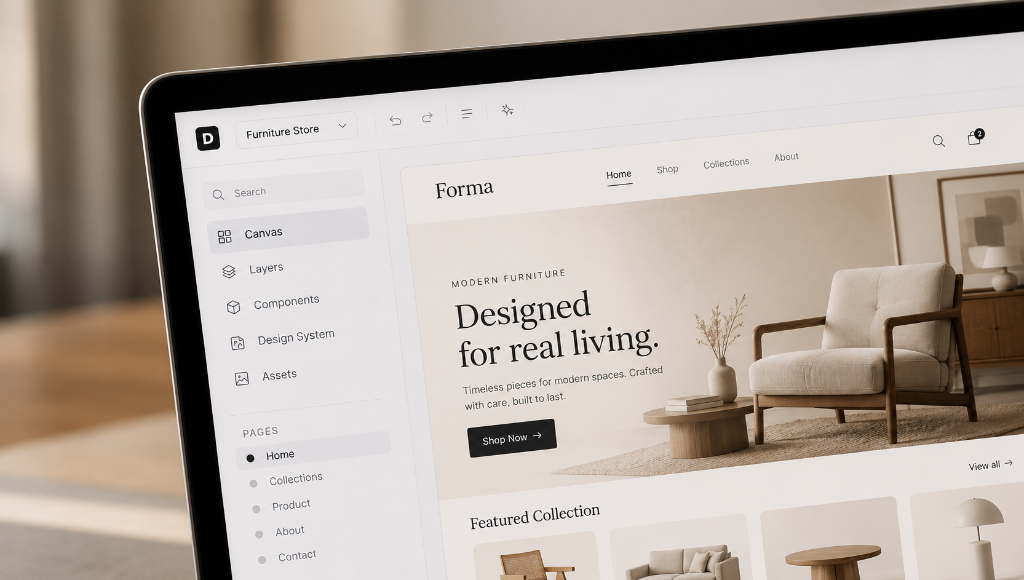
Dizzy turns your voice into editable UI designs. Generate, refine, and iterate directly on a canvas with full project context and design system memory.
Good morning,
Here's what's happening.
Speak. Generate.
Edit. Keep going.
Go from an idea to a complete, editable design in seconds. Make changes by voice, select specific elements, and refine with precision without breaking your flow.
Spoken Intent
Describe screens or flows naturally without clicking menus or wrestling with coordinates.
Canvas Generation
The parser compiles your spoken prompt into a nested document hierarchy with Auto-Layout rules.
Semantic Edits
Target any layer and speak mutations. Change tokens, tighten paddings, or swap variants.
Native Figma Sync
Transfers state into your active Figma document via the desktop plugin with clean layer trees.
Your context.
Always in sync.
Dizzy remembers your project, brand style, components, and previous edits so you can build consistently across sessions.
Maintains an in-memory document tree across prompts and sessions
Dizzy keeps an abstract syntax tree (AST) of every frame, layer ID, and token mapping on the active canvas. When you issue a command, the engine diffs the requested change against the current AST rather than re-evaluating the whole canvas from scratch.
You ask Dizzy to "make the pricing card taller," and then five minutes later say "now add a badge to it." Dizzy remembers the exact target node without requiring you to re-select the layer.
Project context memory
Maintains an in-memory document tree across prompts and sessions
Dizzy keeps an abstract syntax tree (AST) of every frame, layer ID, and token mapping on the active canvas. When you issue a command, the engine diffs the requested change against the current AST rather than re-evaluating the whole canvas from scratch.
You ask Dizzy to "make the pricing card taller," and then five minutes later say "now add a badge to it." Dizzy remembers the exact target node without requiring you to re-select the layer.
patch_node({
  target: "node_pricing_card_82f",
  mutation: "APPEND_CHILD",
  child: { type: "BADGE", label: "POPULAR", fillToken: "brand.primary" }
})Teams and builders
who design at speed.
Dizzy removes the manual friction of drawing boxes, adjusting paddings, and looking up token variables. Here is how different disciplines use voice-to-Figma in production.
Founders & Builders
Turn product ideas into presentation-ready pitch screens without hiring an external agency or wrestling with design menus.
Product Teams
Convert verbal discussions, user stories, and PRD requirements directly into visual wireframes during live sprint planning.
Design Systems Leads
Protect component libraries from rogue hex codes and detached components. Every generated element maps to your tokens.
Full-Stack Developers
Inspect clean Auto-Layout structures that translate directly into Tailwind CSS flexbox and grid containers without manual translation.
Inspect System Architecture & WebSocket MCP Protocol
Explore the complete technical breakdown including AST compilation schemas, local WebSocket bridge topology, and verified latency benchmarks.
Frequently Asked Questions
Dizzy is an interface design agent that translates natural speech into native, editable Figma Auto-Layout components. Instead of clicking through menus or drawing frames manually, you speak your layout requirements. The AST parser compiles your phrases into structured node trees and applies them directly to your active Figma canvas.
This system was engineered as a technical showcase. If you are interested in similar builds, architectural consulting, or private deployment, enter your email below.